Week 3 Learning Maths in Year 2
Dear Parents
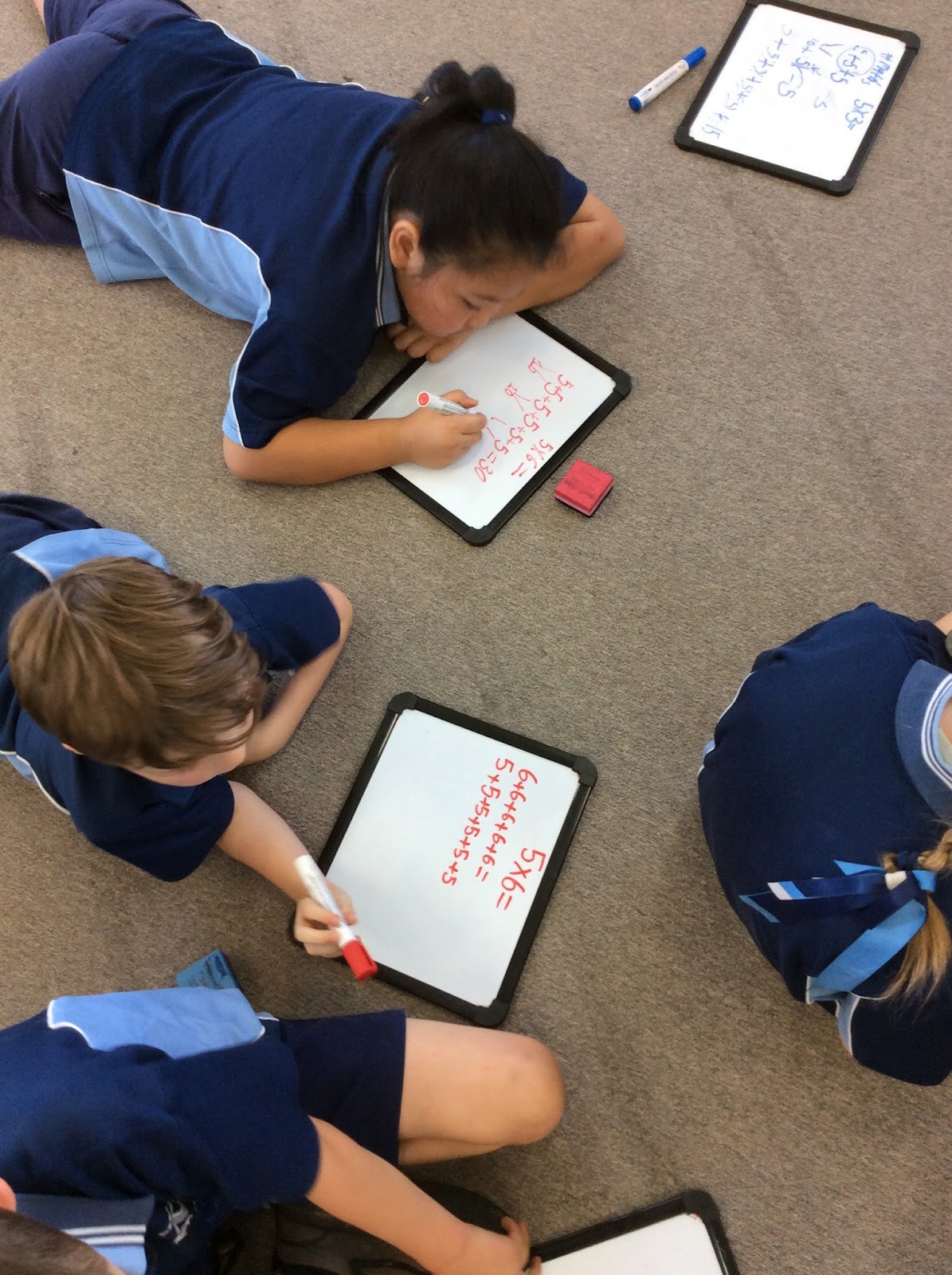
In Maths rotations this week, we have been learning about Time (Telling the time using quarter to and quarter past) and Multiplication (building an array, understanding repeated addition and drawing groups of). However, the students were particularly drawn to Mrs Elliott's group as they were playing Time Bingo and had a great time being competitive to wanting to call out BINGO! Overall, they have shown great improvements with the application of these math concepts and are now more capable to talk about their learning.
Learning to build an array using multi-link cubes.
Completing the multiplication board
BINGO with Mrs Elliott
Repeated addition with branches
Thank you for all your support at home to reinforce the concepts at school.
Yours in learning,
Mrs Lyons, Ms Eyears and Mrs Elliott
Homework Week 5 - Where does tap water come from?
WALT describe how water is transferred
from its source to its point of use.
Activity: Know where water in our taps comes from and goes?
Click on the link below and play with the jigsaw puzzle to learn about water cycles in the city and the country. Read
the sentences out loud each time a puzzle piece is in place.
No Swimming Program Wednesday 18 October
Good afternoon Parents
Given the cooler wetter weather and the low pool temperature, there will be no swimming program tomorrow.
Thank you for your understanding.
Mrs Lyons and Ms Eyears
Maths - Multiplication
WALT represent
multiplication (repeated addition,
groups and arrays)
Dear Parents
We found this easy resource to help you when you are supporting your child to learn multiplication over the next two weeks. The goal isn't to simply learn the 'times tables' but rather understand the thinking and problem solving behind the multiplication algorithm.
We are here to support you both and if there are any questions or concerns we are your best advocates to clarify them for you.
Your sincerely,
Mrs Lyons and Ms Eyears
Link: How to help your child to understand multiplication?
Term 3 Biological Sciences
We are learning to ...
- recognise that living things have predictable characteristics at different stages of development.
- use informal measurements to collect and record observations
- participate in guided investigations to explore and answer questions
As a class we decided to create the miracle of life and grow our very own plant. The students had a choice to grow cress or alfalfa and became responsible for their care. Along the way the students had to observe and document their plant life cycle growth using topic vocabulary, detail and exact labels to enhance their images. The children were extremely excited when they germinated and were able to use magnifying glasses to inspect their plant growth.
Term 4 Earth and Space Sciences
#Earth resources
In Science we are learning to ...
- identify the Earth’s resources including water, soil and minerals, and describing how they are used in the school
Each student were given three strips of paper. On each strip, the students are to describe how Mother Teresa School uses water, soil and minerals. The students had to sort their sentences strips into each category ready to be displayed on the poster.
Some of the responses included:
Maths - Area
WALT compare and order several shapes and objects based on area using a variety of uniform informal units (unifix cubes, multilink cubes, playing cards, counters, animal cards, MAB blocks)
Task: The students explored a variety of objects in the classroom and discussed their areas. They had a busy time exploring, counting, predicting and ordering the area of their chosen objects using informal units.
Subscribe to:
Posts (Atom)